Every person has doubted their abilities at some point. Everyone has questioned, “Am I good enough?” or even found themselves trapped in comparing themselves to impossible standards. But behind that simple question lies a fundamental key that determines the quality of our lives: self-esteem, or authentic self-worth.
In today’s fast-paced era, many people equate self-esteem only with achievements, appearance, or the recognition of others. However, as revealed in the important book The Power of Self-Esteem, there is a much deeper paradigm that is rarely uncovered.
This article will dissect four essential conceptual gems from the book, while also highlighting why you should go beyond simply ‘knowing’—and begin to yearn for ‘how’ to build it authentically. Discover the “strategic teaser” that will open your eyes to the power of authentic self-esteem, yet (deliberately) leave you with a curiosity that propels you to take the next step.
Why Self-Esteem Is a Paradigm, Not a Temporary Label
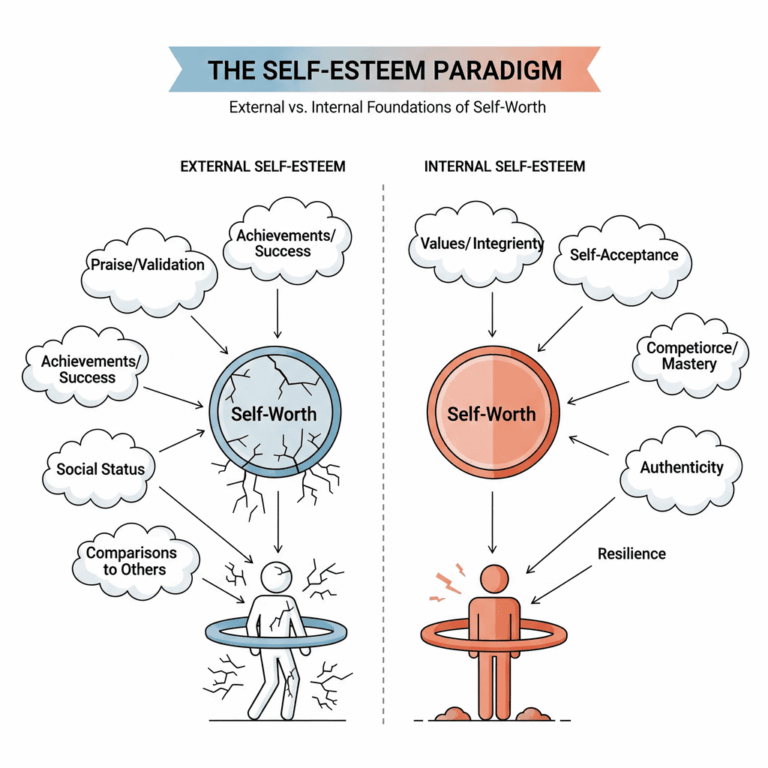
Many people think of self-esteem as a price tag: something that can be attached, removed, or changed at will. However, The Power of Self-Esteem shows that self-esteem is a paradigm. It is not a ‘status’ suddenly gained through academic achievements, recognition from a boss, or a beautiful face in the mirror.
Self-esteem grows as a result of how we conduct our daily lives, how we handle problems, interpret failures, and respond to criticism. The paradigm of true self-esteem is founded on responsible action, the courage to be honest with oneself, and the refusal to be trapped by superficial judgments.
Why is this revolutionary? Because this paradigm breaks the chains of entrapment. If you depend on trophies (which can be lost), or youthful looks (which inevitably fade), your self-esteem will always be fragile. The new paradigm taught in this book urges you to build a foundation of self-value from the inside out—not from the outside in.
“How do you shift the source of self-esteem from external to internal? Its comprehensive practical framework is only systematically revealed within the book…”
Read also : GenderSell: How to Sell to the Opposite Sex by Judith C. Tingley Ph.D.
Commitment to Awareness: The Main Pillar of High Self-Esteem
There is one standout trait among people with high self-esteem: commitment to awareness, or “the will to understand.” They do not go through life on autopilot. Instead, they choose to live consciously—mindfully—in every action, decision, and interaction.
This awareness is not just about being alert to the environment. It is the courage to be honest with oneself, to open one’s eyes to the motivations behind decisions, and to welcome feedback from others. People with high self-worth do not seek validation; they seek clarity: Am I progressing according to the goals and values I believe in? If not, what needs to be corrected?
Why is this important? Because commitment to awareness keeps you “on course.” It is a vital compass in facing challenges and change. When someone loses self-awareness, they are easily trapped in reactive patterns, destructive habits, or even toxic relationships.
“Techniques for building commitment to awareness, complete with proven daily exercises, are only thoroughly detailed in our exclusive guide…”

Read also : The Illustrated Art of Manliness: The Essential How-To Guide: Survival, Chivalry, Self-Defense, Style, Car Repair, And More! by Brett McKay
Authentic Pride: Enjoying Achievements Without Arrogance
One of the classic pitfalls in the journey of building self-esteem is the confusion between healthy pride and empty arrogance. This book points out that authentic pride arises not from a desire to “prove oneself,” but from the satisfaction that grows after doing what is good and right.
People with authentic pride will say, “I did what was necessary,” and feel quietly satisfied. They do not need to showcase their achievements or seek bombastic praise. This kind of pride does not come from an “emptiness wanting to be filled,” but from a “fullness longing to be savored.”
Why is this important? Because authentic pride is a natural shield against feelings of inferiority, failure, and the compulsive urge to outdo others. It fosters a solid self-confidence—without having to sacrifice social relationships, as there is no false competition.
“How do you distinguish authentic pride from false ego? A series of reflective tests and case studies are available only to those who dig deeper…”
Avoiding the Trap of External Validation: The Quiet Path to Wholeness
Oftentimes, people feel the need to please many parties at once—bosses, partners, friends, even “societal standards.” This creates a dilemma: striving to gain approval from one can mean facing rejection from another. If external validation becomes the sole source of self-worth, every rejection feels like a disaster.
This book invites readers to move beyond that trap. By building inner wholeness, you no longer become a “slave” to popularity, status, or the opinions of the majority. Calmness, confidence, and happiness will grow from within—and endure even when circumstances are less than ideal.
Why is this transition important? Because it frees you from collective anxiety, the fear of failure, or the worry of “losing face” in public.
“There are three patterns of self-sabotage that most often keep people trapped in the web of external validation—and the strategies to overcome them are analyzed in depth in the complete version…”
Conclusion: Embracing Change Before You Choose to Act
Achieving authentic self-esteem is a journey, not a destination. By letting go of dependence on external validation, nurturing true pride, and committing to a mindful life, you deserve to enjoy inner freedom and meaningful accomplishment.
However, this knowledge is just the tip of the iceberg. You have now grasped the “what” and “why.” The “how”? That’s where the true magic of transformation lies—and you deserve to experience it today.
You have just seen the foundation. These concepts are only the tip of the iceberg of what the book has to offer. How do you apply them step by step, avoid common pitfalls, and integrate them into your strategy? All the answers are inside.
Sign Up and Get Free Access at MentorBuku Now!