Tag: routines

  • The Proven Secret to Habit Transformation: A Catalyst for a Paradigm Shift in Life. The Power of Habit by Charles Duhigg

    Introduction: Why Habits Determine Your Destiny

    Nearly every aspect of modern life is influenced by habits. From small things like how you start your day to major decisions in organizations and businesses. Often labeled as automatic behaviors, habits are actually the “secret code” that shapes destinies, from personal lives to professional institutions.
    However, behind these routines lies a surprising truth: you can dismantle, reshape, and even create new habits with the right strategy. The Power of Habit—a phenomenal book that has changed the mindsets of millions—unravels the intricacies of habits. But, are you ready to step out of your comfort zone and transform your life?
    In this article, you will understand the scientific foundation of habit formation and change, discover the “why” that has been hindering your progress, and get a teaser of strategies to change your life—but the complete method is accessible at MentorBuku.


    Routine, Reward, Cue: The Foundation of True Habits

    Understanding the Loop: Identifying the Routine

    At its core, every habit consists of three main elements: a routine, a reward, and a cue. This three-step pattern is what makes an action repeat over and over without conscious thought.
    The routine is the behavior we perform automatically—for example, always brewing coffee in the morning. However, behind that routine, there is a trigger (cue) that “ignites” you to do it. It could be a specific time, a mood, or even words heard at random. The reward, on the other hand, is the brain’s prize after performing the routine; it can be a feeling of comfort, calm, or even just a pleasurable sensation.
    A deep understanding of this cycle is crucial. Without knowing what routine is in motion, you will find it difficult to change the behavior.
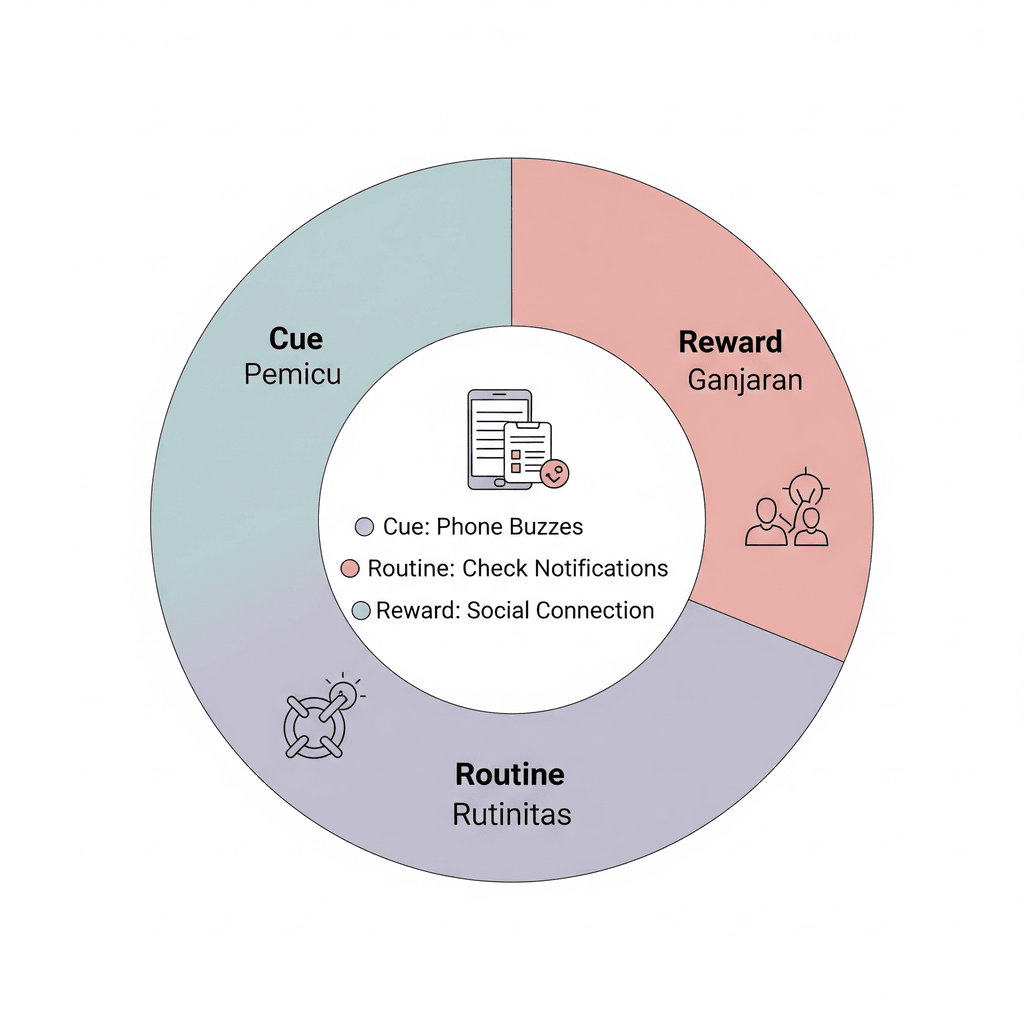
    However, this is the secret: Honestly identifying your routines is the primary foundation for change.
    “A complete framework for detecting and mapping the routines that form habits is available in a special chapter of this book, including sample worksheets and practical tools that you can learn more about at MentorBuku…”

    Experimenting with Rewards: Locking in Positive Behavior

    Even bad habits persist because of a specific reward. This is why, for example, people continue to smoke despite knowing the risks—there is a temporary sensation (reward) they receive. The Power of Habit recommends reward experimentation; a strategic approach to test various forms of rewards to discover the true motivation behind your routine.
    In other words, the process of change begins not just by suppressing the bad routine, but by replacing it with a new, more constructive reward.
    “The step-by-step technique for conducting reward experiments, as well as how to avoid the ‘false reward’ trap, is explored in detail in the exclusive MentorBuku summary…”

    Read also : What Women Want: The Global Market Turns Female Friendly by Paco Underhill


    Isolating the Cue & The Role of Awareness

    The cue, or trigger, is the first thing that must be identified before you can effectively control a habit. A cue can be a time, an emotional state, a location, a specific person, or even a particular thought. Without understanding the cue, attempts to change a routine are likely to fail because you do not know when that “automatic button” is activated.
    Awareness of the cue grants you immense power: the ability to interrupt the automatic cycle that has held you captive. The Power of Habit teaches the technique of cue isolation through observation, logging, and repeated experimentation—until you can finally see the hidden patterns behind the habit.
    But of course, behind this simple knowledge lie complex layers of observational strategies and methods for identifying the cue, which cannot be fully unpacked here.
    “Advanced cue observation techniques, including a daily application journal and tips for distinguishing between external and internal cues, are part of MentorBuku’s premium insights, specially written by productivity practitioners…”


    The Role of a Plan in Shaping Change

    Without an action plan, habit change is just talk. Many people fail because they know “what” to change, but they don’t know “how” to design the roadmap. The Power of Habit presents a highly applicable framework for change: identify the routine, experiment with rewards, isolate the cue, and then create a plan.
    A plan is not just an intention; it maps out concrete steps that are ready to be implemented. For example, if your cue is stress, the routine is smoking, and the reward is relaxation, your plan could be to replace the smoking routine with a breathing technique for the same reward.
    The key is to take full control of every phase of the change. Without the discipline to design a plan, you will fall back into the old patterns.
    “The five pillars of a fail-proof habit change plan, along with templates and real case studies, are only available in full in the MentorBuku summary…”

    Read also : Ikigai by Héctor García,Francesc Miralles

    Lesson for Leaders: Implementation in Organizations

    Habit change isn’t just for individuals. In the business world, large organizations like Starbucks, Procter & Gamble, and even leading technology companies build the foundation of their success by managing collective habits in the workplace.
    Even strategic decisions—such as “changing the color of a main product” in the middle of the production process—cannot escape the influence of the organization’s established habit patterns. Challenging a team’s habits, facing resistance, and building a new culture require a deep understanding of the routine, reward, and cue cycle at the group level.
    Great leaders are able to detect team routines, map out shared rewards, and design positive cues that make organizational change easier to accept.
    “The three fatal mistakes that often occur when organizations try to change habits, and the strategies to overcome them, are dissected in detail with authentic case studies in MentorBuku…”

    Read also : The Art of Thinking Clearly by Rolf Dobell

    Conclusion: The Power of Transformation & Hidden Opportunities

    Habits are not destiny. They are a “script” that you can rewrite at any time with the relevant knowledge. By understanding the routine–cue–reward cycle, and having a structured plan, you open the door to major changes—both on a personal and professional level.
    However, the true journey of changing a habit only begins when you not only understand the basics, but also know the exact strategy to apply it.
    What are the common mistakes? What are some real-world application examples in the professional world?
    The answers are just a click away.


    CTA & Call to Action

    You have just seen the foundation. These concepts are just the tip of the iceberg of what this book has to offer. How to apply them step by step, avoid common pitfalls, and integrate them into your strategy? All those answers are inside.

    Sign up and Get Free Access at MentorBuku Now!

  • Hacking the Automatic Brain: Why We’re Always Stuck in Bad Habits (and What’s Really Happening Behind the Scenes). “Atomic Habits” by James Clear

    Written by
    mentorbuku
    in
    Habits & Behavior, Self-Development, Productivity, Psychology

    H1: Introduction – When the Brain Runs on ‘Auto-Pilot’: A Modern Mystery

    Have you ever realized you’ve suddenly polished off an entire bag of snacks, spent hours scrolling through social media, or even done something boring—like swiping a credit card—without being truly aware of it? The surprising fact is: most of our daily behavior is driven by subconscious habit systems, like the brain switching to ‘auto-pilot’ mode. From shopping to aimless scrolling, why are people so susceptible to bad habits? This is where the domino effect of habits, supernormal stimuli, and modern stimulus systems play a key role.

    In this article, you’ll explore three of the most prevalent habit phenomena in the digital era: the power of auto-pilot brain, the danger of supernormal stimuli, and the secret of the ‘instant satisfaction rating’. We will uncover the ‘what’ and the ‘why’—but the secret ‘how’ to take control is only available in the next realm: MentorBuku.


    H2: The Brain’s “Auto-Pilot” Phenomenon – When Awareness Is Parked and Gone

    In a simple story, someone unconsciously swipes a customer’s actual credit card—it’s not that the employee doesn’t know the rules, but routine has shifted control from conscious intent to the brain’s subconscious layers. Auto-pilot, an informal term for automatic habits, is in fact responsible for so many of our repeated life decisions, made without active logical intervention [1].

    The key to auto-pilot habits is their reliability. The human brain is always searching for the easiest and quickest way to accomplish tasks, so it builds neurological ‘fast lanes’ that can take over behavior automatically. You don’t have to think hard each time you tie your shoes, brush your teeth, or even get ‘pulled’ into your favorite shopping app. In other words, habit is the brain’s solution for saving thinking energy.

    But here’s the problem: auto-pilot habits never choose based on long-term benefit; more often, they rely on past ‘success’ or instant pleasure. As a result, we easily get stuck in endless cycles of bad habits—and ironically, these habits often feel comfortable.

    The complete framework for exposing and breaking the auto-pilot loop is mapped out in the book we’re examining—including techniques for conscious intervention in your daily routines…


    H2: Supernormal Stimuli – The Invisible Enemy of Healthy Habit Paths

    What do junk food, social media, pornography, and modern digital ads have in common? They are ALL products of supernormal stimuli—artificial triggers designed not just to elicit a natural human response, but to amplify it to abnormal levels [1].

    The term ‘supernormal stimuli’ has evolutionary roots. Imagine: fast food packed with sugar, salt, and fat isn’t just food; it’s a work of art that tricks your brain into seeing it as far more ‘valuable’ than natural food. The same thing happens with social media apps: notifications and colorful visuals bombard your dopamine system non-stop, as if every like and comment is a form of instant reward.

    The impact? Consumptive, impulsive habits and addictive routines—which are not just lifestyle choices, but the result of systemic engineering that is tough to escape.

    Yet behind all that, there are three fatal mistakes most people make when trying to fight the current of supernormal stimuli—and they can only be addressed with the latest principles of habit psychology, as analyzed in MentorBuku’s insights…


    H2: Instant Satisfaction Ranking – Why the Brain Always Chooses ‘Satisfaction Now’

    The appeal of bad habits doesn’t just come from their automatic nature. The human brain is wired to prioritize instant gratification, a principle that has become ever more extreme in our digital world [1]. Every behavior (whether opening an app, shopping online, or eating fried snacks) gets repeated because the brain is ‘rewarded’ with a quick hit of satisfaction, even when the long-term consequences are negative.

    The paradox: the greater the immediate gratification promised by a behavior, the harder it is for your brain to resist. That’s why modern humans so often feel ‘powerless’ when trying to start good habits like exercising, journaling, or finishing important tasks—because the brain is programmed to chase the fastest reward.

    Even in a historical context, innovation always moves towards increasing the speed and intensity of rewards [1]: “If history is any guide, future opportunities will be even more tempting than today. The trend is for rewards to become ever more satisfying—which increases the likelihood that the behavior will be repeated in the future.”

    Do not underestimate the power of ‘reward’ in shaping behavior. The main book we analyzed gives you psychological weapons for taking control of the instant satisfaction system—along with ways to redirect your brain to healthier rewards. Yet advanced techniques, including practical templates and how to build a healthy reward system, are reserved for MentorBuku subscribers…


    H2: Why Habit Revolution Is the Struggle of the Modern Era

    Every bad habit is the result of psychological engineering beneath the auto-pilot system, supernormal stimuli, and instant rewards. In the digital era, this problem only grows more complex: artificial stimuli that are super accessible lead the brain deep into the chasm of destructive behavioral dependence. If you’ve ever wondered why it’s so hard to break out of old patterns—even when you know the risks—the answer doesn’t lie in ‘willpower,’ but in the system behind your own brain.

    However, knowing the ‘what’ and ‘why’ is merely a foundational step. True transformation never happens without tools, concrete steps, and strategies to “trap your own brain”—that’s the secret you’ll only get if you’re willing to leave the comfort zone of shallow knowledge.


    H2: Conclusion – When Knowledge Is No Longer Just Information, But a Transformative Key

    After exploring the power of auto-pilot, the danger of supernormal stimuli, and the dominance of instant gratification—one major conclusion emerges: without the right strategy, modern humans will only become victims of their own sophisticated habit systems. You’ve seen the foundation of ‘why’ change is so hard, and what the earliest traps are. But, your life’s turning point isn’t “what” you know, but mastery of the “how”: breaking down, redesigning, and conquering your habit system at a technical level.

    You’ve just seen the foundation. But ‘how’ do you build the skyscraper? We’ve unpacked all the strategies, detailed steps, and case studies from this book. Don’t just know the ‘what’—master the ‘how’ by subscribing at https://mentorbuku.com.